viernes, 18 de septiembre de 2020

New theory to create the Intelligent business management System (IBMSYS)


    In business administration, it has been possible to establish management by processes and the accounting record of its transactions as two (2) fundamental principles or laws. If properly applied, they would allow the implementation and control of the management systems in each area, directed by their administrative manager as part of their planning work. The quality management and office software support engineers would install the core system and train, integrate and support. It could be implemented in parts, but it could be done simultaneously in many, because each one would work on their own without interfering with the others and the learning could be done online.

    How did I arrive at this conviction? Studying the trauma to companies that the implementation of systems by external consultants causes, given that they must learn from internal experts, they adapt the systems to the requirements they deduce from this hasty learning and impose the modules to be implemented, often with failures of uncertain solution. The image of know-it-all consultants is nothing more than that: an image, they reserve knowledge of the system and only train users once it is implemented.

    Companies must use their own resources to implement and maintain their management system in order to ensure autonomy, they cannot continue to depend on third parties for this, which is the backbone of the administration. It requires advanced software to achieve this, making that software available is our job.

    In 1969 I was 19 years old when I entered the Colombian Ministry of Finance as a computer programmer (see certificate), I had advanced 2 years of Engineering at the National University in Bogotá (see certificate) when I was declared fit by IBM to develop software and I received the training. The Ministry of Finance was for me an excellent basic Cobol programming school.

    At the age of 21, Top Managment, a recruitment company of Arthur Young & Company integrated today into Ernest & Young, linked me to the nascent Pavco S.A. in its first headquarters south of Bogotá. With Arthur Young's advice we developed a Sales and Production Management System, in Cobol language, which served as one of the bases for the exponential growth of the Company until it became a multinational. Pavco was for me the University that specialized in business management, including the production process of vinyl floors, plastic pipes and nylon and polypropylene mats. I had great Teachers: Edmundo Ezquenaci, Jimmy and Charlie Meyer, Gustavo and Eugenio Ángel, Adolfo Di Capua and Arthur Young's advisers, among others.

    A well-deserved rest in the flat lands where my ancestors came from led me to a new passion: the countryside, the savannas and the jungles of Colombia.

    As an independent developer for companies in Colombia and Venezuela, I managed to save enough to partially finance a colonization of Guaviare with peasants displaced by the violence of Magdalena Medio, we managed to help create 2 villages, Las Delicias and Las Brisas, on the edge of the now famous reserve natural and archaeological site of La Lindosa. I was notified by Voz del Guaviare if one of my Clients required my services and flew to attend to him, until the war displaced us in 1991 (see article).

    Back in Bogotá we continued with SoftCol Ltda., A company that we founded in the 1980s with several colleagues. Among other tasks, we help more than 40 companies to brand new Olivetti minicomputers with Basic language and floppy disks, predecessors of the PC. We systematize from warehouses, small factories, multi-asset cooperatives, tourist and cargo brokers, insurance and real estate brokers and an Italian insurance company. Official companies such as the government of Cundinamarca and the Revolving Fund of the National Police. In Access and Visual Basic I developed the Payroll for ElectroCordoba employees, workers and pensioners.

    It was necessary for us to create a product program to be able to compete with the large international software houses, but despite making considerable progress in the development of a system based on Unix and C language, and to implement the model at Casa Mettler (see image of the certificate see text of the certificate), we could not make mass implementations and we broke.

    In order to continue developing software, I created companies such as a community housing association and its construction company and I systematized them with Access. I investigated agile tools to develop web software, such as CodeCharge Studio, with which I developed a software for management of educational institutions, implemented in Maicao, Guajira, and a management of support for refugees in Venezuela, among others. I made an attempt to return to the countryside near Tayrona Park, wanting to retire, but the subcommanders of the capo Hernán Giraldo displaced me (see article) I think because I found out the new dispossession of the peasants under the protection of the consolidation zones of Plan Colombia ; territorial control is still exercised by this mafia and is preparing the return of its leader after paying an extradited sentence in the US. The Victims Unit investigated and found a study confirming the fact (see certificate) 2015 again in Bogotá.

    2019, 50 years of professional practice, and I continue to develop Software.

  To the point, I present the design of the Intelligent Business Management System, it is ready to program, so I am forming 2 teams: development and subsequent maintenance and complementary expert system to achieve the implementation or mass migration:

Design of the Intelligent Business Management System

Design of the programming of the Intelligent Business Management System

    The most used development tools in the world are simplified, overcoming excessive and wasteful schemes, increasing productivity and effectiveness: Language selected for the development of SISGEI: JavaScript with Node.js and some Node Package Manager (npm) packages to speed up and standardize. IDE (Integrated Development Environment): Visual Studio Community released by Microsoft for open source people. SeeIDE started to test the SISGEI database.

    Cordially,


Hernan Pardo Silva

miércoles, 8 de abril de 2020

Máquinas inteligentes para construir planetas habitables


Introducción.

La Humanidad se ha reproducido tanto que no puede seguir haciéndolo confinada en este planeta por alto riesgo de autodestruirse. Ademá la tierra puede dejar de existir o de tener las condiciones adecuadas para la vida de los hombres por razones ajenas a la voluntad humana. Tenemos que lograr, cono dice Elon Musk, que “los humanos se conviertan en una especie multiplanetaria”i para lo cual la empresa SpaceX tiene como objetivo crear una colonia humana en Marte de un millón de personas.

Otra opción es fabricar enormes naves espaciales, planetas artificiales, con capacidad para que millones de seres humanos puedan tener una vida sostenible y productiva, y que logre hacerse viral. Por ejemplo se pueden construir enormes Cilindros de O'Neillii con base en asteroides y de máquinas inteligentes controladas a distancia por un pequeño grupo de administradores e ingenieros.


Módulos espaciales habitables.

Se podría iniciar construyendo una nave espacial en la tierra que transporte un módulo habitable sostenible para unas cuantas parejas humanas, que tenga la capacidad de duplicarse con materiales encontrados en el espacio, tomados de asteroides, para seres humanos que viajen desde la tierra o desde otras colonias o que nazcan en los módulos. Deben tener “casas”, “cultivos” y “fabricas” para producir lo necesario a la supervivencia, además deben poder construir otros módulos iguales o mejores que puedan ensamblarse al modulo “madre” o iniciar otro grupo. Es de esperar que se desate la innovación con los materiales encontrados en las nuevas circunstancias, continuando con la diversidad a una escala cósmica.iii


Conjunto de Empresas humanas para vivir en el espacio exterior.

Ideal sería que desde su inicio la colonización espacial tenga una imagen virtual de los procesos de planificación, programación, los ejecutados y sus controles de calidad, ambiental, laboral, etc., para lo cual se requiere de un Sistema de Gestión Empresarial en una nube espacial, mediante una red de servidores ubicados estratégicamente y conectados con la mayor eficiencia, que contenga las aplicaciones y los datos de todos los emprendimientos que se realicen para iniciar y continuar la colonización del espacio.

Sistema de Gestión empresarial Inteligente.

Sería oportuno iniciar la selección de un sistema ideal para la gestión de la colonización espacial y empezar a aplicarlo en la tierra para someterlo a corrección de fallos y mejora continua. Un sistema con capacidad de entender cualquier otro ERP y sus complementos o similares actualmente en uso, con la posibilidad de hacer migraciones automáticas en los 2 sentidos para poder hacer grandes consolidados y para aprovechar las aplicaciones de análisis de sus datos en uso. El nuevo sistema debiera sintetizar las teorías administrativas en una propuesta simplificada por el avance en la comprensión de las leyes que rigen las empresas humanas.

He publicado en este blog el diseño general y el diseño de la programación del IBMSYS que pretende corresponder a los requerimientos expresados. Pueden leerlos en los enlaces siguientes:


Agradecería sus comentarios y sugerencias.


sábado, 15 de febrero de 2020

DESIGN OF INTELLIGENT BUSINESS MANAGEMENT SYSTEM (IBMSYS)

Introduction.

Carlos Marx envisioned that accounting would be increasingly important for business management. In Volume II of Capital, Chapter IV Circulation expenses, in numeral 1. b), it defines: “… Accounting, on the other hand, as an ideal control and compendium of the process, is more necessary the more social character this process acquires and more loses its purely individual character; it is more necessary, therefore, in capitalist production than in the scattered production of artisanal and peasant enterprises, and more necessary still in collective production than in capitalist production. ”

Our intelligent business management system (IBMSYS) requires that all economic information be qualified by accounting concepts, contained in the account plan, and that its registration and evidence be made only as accounting transactions. With this we can achieve that "control and ideal compendium of the process" is total, using the necessary contingent and control accounts. As a result, a minimum of related information entities and a minimum of algorithms to be programmed are achieved.

The implementation and updating of current business management systems (ERP, CRM, SCM, etc.) requires titanic efforts because the cost and time involved and the chances of failing in the attempt traumatize the adequacy of companies to new technologies of information and telecommunication and the progress of international trade. To guarantee the success of these efforts, a small number of highly specialized consulting firms have been accredited, in exchange for rising costs and user dependence.

A simplified system is required that, due to the advanced synthesis of administrative theory, is more concise but deeper than current systems, achieving its easy understanding by the technicians and professionals in charge of business support areas so that They can implement and update it, preferably directed by the Quality Management Department, with the unrestricted support of senior management. The implementation and updating of business management systems should cease to be the privilege of highly specialized external consultants.

System oriented norrms-based processes.

Process-oriented business management has managed to close the gap between theory and business reality. The need to offer customers products according to their specifications or expectations and to maintain uniformity in the products or services of the same reference motivated the emergence of control, monitoring and quality management, It was a great success of the International Organization Standardization (ISO) manage to synthesize these theories in ISO 9000 because in a few decades it has been implemented in the vast majority of important human companies.

Companies implement it massively to improve production, achieve recognition and facilitate distribution. They should also implement ISO 14001, environmental management and ISO 45001, occupational health and safety management. Companies that have any relationship with human or animal feed should implement ISO 22001 for food safety management, etc. Towards the future the tendency is to continue simplifying these norms because their success has been due in large part to the fact that they managed to synthesize administrative theories, varied and contradictory at times, simplifying the creation of the global business network, taking advantage of the evolution of the technologies of information and communication, so that we reach the predominance of online commerce.

Accounting as a tool for conceptualization, registration and control of economic information.

The vision of accounting as the mental image of the production process has great flaws in the current practice of business management systems, insisting on making separations derived from the tendency of accounting managers to limit their scope. With the new systems the accounting offices tend to disappear; accounting criteria of the administrators is required for the control and analysis of the information, the accounting record work is done automatically. It should not be allowed to consider some economic management registration systems as complementary or parallel to the accounting systems, use of the order accounts to involve them using the contingent and control accounts.

Expert system for implementation.

ISO 9001 applies to all types of companies, the design and development of products and services is optional because there are companies that buy to sell without transforming, such as shops and service commissioners, others add some of their own complementary products or services, and Many must be designing and developing in order to stay in the market. ISO 9001 can be applied to the entire business structure, the other norms clarify or add other specific controls.

By investigating, we will build a tree of possible implementations in such a way that, as it grows, it is more times that we will find a product ready to implement than the need to create new branches and sub-branches to satisfy a new type of Company. Interviewing the experts of the interested Company, in order to locate it in the implementations tree, can be replaced by access to the already registered information of that company in government or union censuses, tax returns, and records of purchase, sale and production declared. A government committed to standardization and simplification could well request all the necessary data for a rapid implementation of the IBMSYS. Thus we could evolve to expert systems and then to intelligent machines of implementation.

Transactional expert system.

The business operation generates instances of predefined processes that combine information analysis and action decisions, when the information is completed and authorization exists, the system can automatically decide on an action. The actions can be of a single instant, like receipt of payments to an invoice or automatic liquidation of a depreciation, or they can initiate an operation that involves other multiple steps such as a credit sale or an automatic production order. In all cases, one or more offset sets of accounting charges are generated that optionally affect contingent accounts, such as annual sales budget or pending orders, and inventory accounts and their results (Assets, Liabilities, Equity, income and expenses of a period ). The affectation of Persons and Things can be determined by the accounts of the Asset, of the Liability, of the Patrimony or of the Debtor and credit contingencies involved.

The steps of the processes that imply an economic change contain descriptions, acronyms, format of the Form of visualization and capture of complementary data, format of the Report for printing and to store the complete transaction, and data of defined occurrence for each type of document that detail how forms, reports and imputations are generated. This will allow the creation of information trees to know how known information should be displayed and unknown information should be requested, how it should be accounted for and how the transaction evidence document should be constructed. That algorithm would be the core of the transactional expert system and would use previous data plus those supplied by the user, flags of the affected accounts and indicators of special deals. Specific algorithms by type of transaction would be terminated and new types of transactions could be added creating the step in the corresponding process, without increasing the code.

The preparation of interactive transactions must allow the procedure to be suspended, without losing the advance, when the user requires it, a transaction must be able to be prepared in more than one session and, in some cases, it must be able to be delegated to another user and also be able to collaboratively do between Multiple users For example, the preparation of the annual budget should involve the administrators of the different dependencies of the Company. Simultaneously several users must be able to be working on the budget, each in their area. Once these steps have been completed, the preparation must be transferred to a budget consolidation committee and the members of this committee must be able to work in all areas until the consensus is approved by this committee, and later by the senior management.

Let's look at the general system flowchart:


The System Database

The data necessary to manage companies seek to meet the needs of all types of ventures. Proprietary systems such as SAP, mixed as Odoo and open and free software as Idempiere have been implemented in hundreds of thousands of Companies. But its databases are very complicated, Idempiere has more than 800 tables with many relationships that hinder their understanding and restrict potential volunteers to improve the code. Odoo has more than 100 that is 8 times more synthesized in its data than Idempiere. Our IBMSYS system has 26 tables, 4 times more synthesized than Odoo. How was it possible to simplify so much? Using the possibilities of the order accounts it is possible that all the economic information is recorded in accounting and it is also possible to have a unique algorithm to process all possible transactions in any type of company.

Let's see how a database with 26 tables replaces the 832 of Idempiere and the 107 of Odoo without losing information. This is achieved by preserving the necessary entities to relate the information of Persons things and concepts, plus the information to control access to the system, the definition of productive and administrative processes and the registration of transactions. The rest of the information, specific to each type or subtype of transaction, is accessed only through some register or tuple of the relational entities, so those can be in a single file, which we could call Add-ons, managed in relative shortcut the structures of that information, the initial direction of recording and reading and the size. Robust database managersii support this type of add-ons as part of the logical transaction, allowing the consistency of the information to be maintained, even in the event of a System crash. Thus, a simplified relational design and higher operating speed are achieved, and a variable design with which we can modify the structure of some data without modifying the code. The definition of the different complementary data needs by type of transaction is established and processed as additional information of a single unaltered algorithm, both for known types and for those derived from improvements or expansion of operations. The management of variable data in business was synthesized.

Let us see in a diagram the 26 tables with the necessary relations to easily access the information, except for the relations of the Companies table with the other tables shown in another diagram.

ER diagram, IBMSYS relational database:
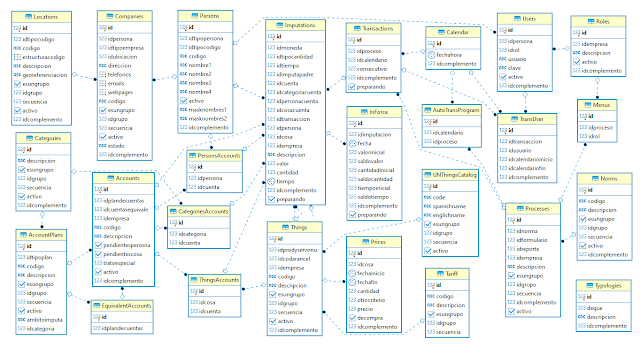


Simplified data, entities (26) and relationships.


It is only necessary to establish the geographical locations of the Companies and their different dependencies, because that is where the Persons work, the third parties are served and Things are located.

Persons who establish business relationships begin to act as Companies. A Person may be related to one or more Companies, may serve as one or more IBMSYS Users. Each User can perform one or more Roles, totally or partially, according to the assignment of tasks of the personnel plant and the restrictions that the bosses can define.
Each Role can perform one or more steps of the Processes through Menus where those options are shown, pending issues and dashboards that summarize how the role is being played.

The Processes should correspond to the Norms that are applied in the Company, such as quality, environmental, labor, etc.

Persons related to the Company affect one or more accounts and an account may be affected by one or more Persons, this is expressed with the PersonsAccounts table that are related to the Persons and Accounts tables; Examples: Partners, Workers, Customers, Suppliers, Competitors, etc. Similarly, the ThingsAccounts table relates the Things and Accounts tables; Examples: Raw materials, merchandise, consumer items, fixed assets, logistic, financial, processing services, etc. Things have purchase and sale Prices that vary with time and other circumstances.

Sometimes it is necessary to see the accounting information grouped transversely, examples: Analysis of income and expenses by cost center or by consolidated projects that can group many products and services, for this we use the Categories table with 2 possibilities: related to the Accounts by table the CategoriesAccounts table, when it is required to analyze information of a lower level than defined in the Account Plans or Categories directly related to the AccountsPlans table. This relationship can be complemented by business dependence. With these relationships and taking into account that the historical accounting movement is in Imputations and InForce tables, times and amounts currently pending are in force, financial reports and dashboards can be produced.

The Assets, Liabilities, Equity accounts and their results make up the first attributable scope, that is, the imputations of a transaction referred to this area must always add zero (0). But the management of contingencies, for example, budget or pending orders, require other imputable areas because the imputations in each of these areas must also always add zero (0). This is defined in the AccountsPlans table ambitoimputa column.

Companies can be independent or be part of a group, move some Accounts through the PersonsAccounts relationship because each Company is a Legal Person.
Governments, or custom, define Account Plans that Companies must use and, how it is possible for a group of Companies to operate in different countries, it is necessary to be able to present the same accounting information classified according to different account plans, which can be achieved using the EquivalentAccounts table.

The Processes table has one row for each step of these processes that are generally for information and transaction consultation; from multiannual planning, annual budgets, production, maintenance, warranty, purchase or supply programs, etc. up to sales orders and invoices, receipt reports, income receipts, proof of discharge, etc., and automatic settlements when certain criteria such as tax settlement, depreciation, valuation, inflation adjustments, year-end closures, etc., are met. All these processes and many more generate transactions and all will be typified as steps in the Processes table. The AutoTransProgram table relates the automated transaction program with Processes and Calendar, activating them when the time comes and they are authorized by a User if required. All other transactions are activated when an authorized User orders it and the necessary information is ready.

The transactions generate from 2 to thousands of compensated imputations that are recorded in the Imputations table, always measuring their value, in any national and / or virtual currency, more quantity and time if necessary. Some imputations generate or initiate a validity of an account payable or receivable, of a continuous supply of an article for several periods of time, of an item of a contract that is maintained until its objectives are met, of a reference of a production program that enters to be executed, etc., for which it decomposes into maturities, which are kept in the Valid table while they are managed, to program in time the values and quantities involved, necessary when analyzing cash flows or schedules of pending operations .

The rest goes in a single file apart from the relational tables. Blocks of information such as the details of the Processes, or the complementary data of the Transactions, the Imputations and the InForce.

The Things must correspond to the classification of products and services of the United Nations, UNThingsCatalog table and, if required, the tariff position will be in Tariff.

The Things can have 2 relations, even simultaneous with Imputations because the value of the imputation depends on the type of currency (IdMoneda) and its change, which are found in the Things and Prices tables. The other relationship can be presented when an imputation refers to a thing, but does not generate pending, for example the cost of sales of an item. It is necessary to be able to report sales costs per item.

The Persons table can be directly related to the Imputations table when it is a movement that does not generate pending in the InForce table, examples: a cash sale. It is necessary to be able to report sales per customer, including cash.

The Imputations can be related to records of the same table as in the case of the imputation generated by an account receivable and the imputations that pay that debt.

The Companies can be part of more or less complex conglomerates, their national tax unit defines a level of accounting, but it is necessary to subdivide for the local tax, so that the accounting allocations must be detailed at least at the level of the accounts that affect, but may be more detailed as in the case of inventories that require defining the dependency, warehouse, shelf, row and height, or warehouse, in which they are located. IBMSYS allows all the detail that is required without ceasing to define the level of accounting and consolidation levels thanks to the fact that the Companies table has a tree structure where the root corresponds to the maximum business consolidation with the possibility of also consolidating the branches or sub-branches that are wanted, establish the level of accounting at will and detail the dependencies without restriction. The sheets will be the most detailed subdivisions.

Several tables have a tree structure: Locations, Companies, Categories, AccountPlans, Things, UNThingsCatalog, Tariff, Processes, Roles and Norms. Accounts has no own tree structure, but inherits AccountPlans.

To ensure that the accounting charges can discriminate more than the accounts, the Table of Imputations inherits the Company to account for Accounts, but may have a more detailed one, to specify the dependency affected within the same Company.
The TransUser table is a log of the Users for each session, with start and end dates, in which they acted preparing Transactions.

The Imputations table is the one that has the most relations to facilitate the consultation of the detailed history and what is pending in its InForce dependent table.

The following diagram shows the additional relationships of the Companies table with the other tables. The Accounts are related to Companies at Legal Entity level subject to the administration of national taxes or lower if it is required to detail to be able to declare local taxes or because senior management decides, for which different levels of Things can also be established and Imputations Roles and Processes can define other convenient levels including conglomerates of Legal entities. All levels can be consolidated.
|


Conclusions

It is possible to create an Intelligent Business Management System based on an advanced synthesis of business information. First: using only the accounting for the economic registry, the order accounts are used to register the assets of third parties that the company manages and to include all contingencies, and second by typing all business economic transactions in a single Entity, to store its formats of forms and reports, how they are filled out and how they are accounted for.
Transactions generate offset debit and credit accounting movements (Imputations) that can be a minimum of 2 to thousands. An accounting movement can start a scheduled process (InForce) with maturities by values, amounts or time, whose breaches generate corrective or penalties. So the pending to manage begins with a generator event as the parent of the events of its development.
Business management processes are framed in international norms, with ISO 9001 as a universally accepted reference, so that the other norms are complements to manage specific controls. Process management should be based on information for decision making and the activation of transactions that can be automated in large part, allowing only very justified changes, based on experience and strictly audited in order to promote continuous improvement, without losing the connection with the already registered. Authorized users assume roles that are defined as the ability to execute a subset of options to inform and activate transactions. There will be more and more automaton users that must be supervised by human beings.
Once the IBMSYS has been developed and tested, implementation can be facilitated in companies that currently use ERP / CRM / SCM systems and others, by programming automatic conversions based on the work of groups of researchers studying current systems such as SAP, COMPIERE and their derivatives, ODOO, etc., in such a way that part of the current code of these systems may become IBMSYS data.
The information recorded would simply change format and can make migration almost transparent to users. A new database to help future implementations will be extracted from what the research groups of the old systems synthesize, in addition to the qualitative record in the new implementations and migrations, which will mature an expert system that in the future could Implement almost automatically, acting as an intelligent machine.
Research groups for the migration of old to new systems should specialize for each product and possibly in certain types of companies. For example, in the Universities you can promote groups of researchers studying current systems in related areas such as: the oil and mining sector, the government sector, the industrial sector, the commercial sector, the health sector, the financial sector, etc. , detailing according to the scope of the systems implemented, with the possibility of consolidating models by their common processes.


Once the IBMSYS has been implemented in a company, it would be advisable to allow the operation in parallel with the previous systems for a reasonable time, transferring the daily changes and movements in automated batch processes, first from the current system to the new one and then the new one to the replaced one.iii


iHernan Pardo is developing business software since 1969. He was trained as a Software Engineer by IBM in Bogota. You can see a summary in spanish of his professional life and his proposal in this blog post: https://hernanpardosilva.blogspot.com/2019/03/nueva-teoria-para-crear-el-sistema-la.html

iiAlibaba Cloud provides services for most of the SQl and NoSQL database managers. For example, Postgresql is indicated for the IBMSYS database because it is robust and handles Large Objects that serve to store the required Add-ons, preserving the integrity of the logical transaction even in case of falls and recovery. See: https://www.alibabacloud.com/product/apsaradb-for-rds-postgresql

iiiThe most convenient processing now for business management systems is SaaS (Software as e service) given the reliability and agility provided by large cloud services. See: https://www.alibabacloud.com/knowledge/what-is-saas
The trend of enterprise software is on the one hand towards integration, but is still called ERP includes CRM and other supplements, on the other hand local systems give way to Saas cloud. See: https://www.cloudmasters.es/un-pequeno-analisis-de-la-decada-en-lo-referente-a-cloud/
“What is an ERP: Complete guide to choose the best ERP of 2019”: https://papelesdeinteligencia.com/que-es-un-erp/


jueves, 17 de octubre de 2019

HOLLMAN ALCALDE DE BOGOTÁ 2020-2023 PETRO PRESIDENTE 2022-2026


Los progresistas, mayoría en el Polo y en la Alianza Verde, tienen candidato a la alcaldía de Bogotá: Hollman Morris

         La coalición de Claudia López, Jorge Enrique Robledo y Sergio Fajardo nunca ha ganado nada, pero pretende manejar a su antojo a la Alianza Verde y al Polo Democrático. Sin aceptar consultar directamente a las bases, utilizando encuestas amañadas, han logrado ser candidatos a la presidencia y ahora a la alcaldía de Bogotá.
         Las bases de estos partidos son mayoritariamente progresistas, viejas y nuevas ciudadanías que anhelan un país en paz y con justicia social, han sido llamados a votar por Fajardo y ahora por Claudia, tratando de imponerles una disciplina para perros contraria a su espíritu independiente. Claudia López desvirtúa toda su verborrea anticorrupción por ser cómplice de la planeada estafa a los dineros públicos mas grande en la historia de Colombia: el metro elevado.
         No lo lograron con Fajardo y tampoco lo van a lograr con Claudia porque enfrentan la coherencia de la Colombia Humana, de la UP y del MAIS, y las teorías probadas por Gustavo Petro en el periodo 2013-2016, razones apabullantes ante los llamados al voto útil de unas supuestas mayorías que solo existen en las mentes de los 3 personajes coaligados. Mucho logró la Bogotá Humana a favor del pueblo bogotano, aún con minorías en el Consejo y de grandes ataques de la derecha nacional.
         Hollman Morris va a ser el próximo alcalde de Bogotá por su trayectoria de lucha contra los Victimarios del pueblo colombiano: investigaciones televisadas de los crímenes de las mafias en contubernio con las oligarquías y su destacada actuación administrando el canal capital de tan grata recordación. Como concejal ejerció control político implacable a la alcaldía de Peñalosa. Comprometido con el programa de gobierno para Bogotá de la coalición Colombia Humana-UP-MAIS. Hollman respondió con altura a los ataques ruines y bajos contra su familia tramados desde los nidos de víboras de los abogados uribistas.
         Los tibios no pasarán así los financie abrumadoramente la plutocracia, los bogotanos van a demostrar su madurez e independencia política eligiendo al candidato que sin duda enfrentará a las corruptas fuerzas dominantes, frenando el metro elevado y construyendo el subterráneo. Va a iniciar una era de grandes cambios, la nueva era de la Colombia Humana que sí va a lograr el progreso y la paz con base en la justicia social.

Hollman alcalde de Bogotá 2020-2023
Petro presidente 2022-2026

viernes, 30 de agosto de 2019

Propuesta de conciliación para la política rural y agraria de la Colombia Humana, indispensable para construir paz


Se basa en 2 documentos, uno coordinado por María Mercedes Maldonado llamado “COLOMBIA HUMANA: POLÍTICA RURAL Y AGRARIA” y otro sintetizado por Hernán Pardo Silva llamado: “Plan progresista para la reforma rural integral”.
         El primer objetivo del plan progresista para la reforma rural integral (RRI) es lograr la paz real. Solo será posible derrotando en las urnas el continuismo que defiende privilegios abusivos de las oligarquías tradicionales, de las mafias de terratenientes, narcotraficantes y mineros ilegales, y de los carteles de corrupción. Aunque la insurgencia espera que, con la decadencia de las potencias occidentales que frustraron la tomar del poder a finales del siglo 20 más los canales de interlocución iniciados con las FFAA, se posibilite una insurrección revolucionaria.
Las 2 propuestas coinciden en el diagnóstico de la situación rural actual pero, mientras la primera se enfoca en dar continuidad a los acuerdos Gobierno-Farc, que parece no se cumplirán, enfatizando la búsqueda de justicia social en el campo y de equipararla con la satisfacción de derechos urbana, la segunda define la anomalía rural principal en la existencia de una ganadería extensiva que usa muy mal el 80% del suelo productivo, 40 millones de hectáreas para sostener 25 millones de reses, con grave deterioro por compactación y erosión y fuerte contaminación de los suelos, del aire y de las aguas. Es de lejos el principal problema ambiental del país, el segundo es la contaminación y degradación de los suelos ocasionada por la minería ilegal. Un gobierno progresista debe declarar la ganadería extensiva ilegal y forzar que se transforme, el plan prevé hacerlo en 20 años. Se lograría liberar el 90% de esas tierras para hacer la reforma rural integral. Empezar por las tierras más próximas a los centros urbanos y con los campesinos sin tierra y los trabajadores rurales más alejados que sobreviven allende la frontera agrícola en actividades agrícolas de sostenimiento, narco cultivo o minería ilegal. La mayoría de los potreros están siendo ocupadas en forma ilegítima ya sea por invasión de baldíos o por despojo a los campesinos o grupos étnicos. Si están legalizados en su mayoría tributan un impuesto predial mínimo, que podría ser la base para la expropiación parcial pagando en bonos. Los actuales poseedores podrían conservar la parte necesaria para los ganados y la que puedan tecnificar a corto plazo.
         Los planes territoriales para la RRI deben ser consensuados con los potenciales beneficiarios, pero, ejecutados verticalmente, como una gran empresa, porque estos no tienen el conocimiento, las maquinarias, el dinero ni los mercados para poder aumentar la producción en forma acelerada.  Se requería que la “inteligencia agropecuaria nacional” pase de recomendar, asesorar y absolver consultas, a dirigir, capacitar, invertir, estudiar mercados y conseguir socios estratégicos. Pero necesitan ayuda de colegas extranjeros.
         Empezar ubicando los mercados: países, ciudades, gobiernos, grandes industrias alimenticias. Las potencias occidentales están en proceso de decrecimiento de sus burbujas de desarrollo hegemónico, los países satélites ya no quieren serlo más, son mercados saturados decreciendo. Pero están surgiendo otras potencias que cuentan con mercados de gran crecimiento, nuevas clases medias con capacidad de darse gusto. Tienen tecnología igual o mejor y gran poder financiero, tienden a desarrollar nuevas relaciones internacionales mas estables y duraderas. China lidera esas nuevas potencias con sus propuestas de coexistencia pacífica basada en el comercio justo, su gran capacidad de financiación, su alta tecnología y sus estrategias de destino común de la humanidad, la franja y la ruta, etc. Los gobiernos corruptos de Colombia han desperdiciado estas oportunidades. Por ejemplo, China aporto el 90% del estudio detallado que construyó el plan maestro del río Magdalena, pero en más de una década no se avanzó sino en la navegabilidad del bajo Magdalena, empantanada por el caso Navelena. Santos no pudo o no quiso concretar la propuesta china de convertir a Coveñas en una gran ciudad industrial a mitad de camino entre China y los mercados de EEUU y Europa con la construcción de un tren de 220 km hasta el Pacífico y un puerto. Hasta ahora nuestros gobiernos nacionales obedecen a intereses de los oligopolios locales y de trasnacionales, sacrificando el bien común.
         El plan progresista de reforma rural integral propone una revolución que aumente en 20 años 10 veces la producción agropecuaria con base en los 36 millones de hectáreas que se recuperarían al poner fin a la ganadería extensiva, más los 7 millones usados hoy en agricultura. Hay que reforestar millones de hectáreas para reparar las cuencas y garantizar riego permanente general. Los campesinos e indígenas están dispuestos a iniciar trabajando y estudiando, actuando como mano de obra no calificada para la construcción de nuevas aldeas campesinas, la infraestructura agropecuaria y de las industrias complementarias. En unos años ya serían técnicos laborales o profesionales y podrían recibir los títulos de sus viviendas y sus fincas en plena producción, superado el punto de equilibrio y estabilizados lo mercados. Las familias campesinas las obtendrían con subsidios y créditos blandos.
La RRI deberá ser ejecutada por una empresa nacional que se especialice en desarrollar proyectos productivos agropecuarios a gran escala, creando millones de unidades de producción familiar campesina y coordinándolas. Empresa conformada por expertos profesionales y científicos nacionales y de los países que van a comprar, financiar y ayudar a tecnificar nuestra producción.
         No estamos proponiendo escoger entre los 2 modelos, al contrario, se deben sumar con los mínimos ajustes necesarios. La reforma rural integral debe ser revolucionaria o no triunfará.
Anexos:

viernes, 15 de marzo de 2019

Nueva teoría para crear el Sistema la gestión empresarial Inteligente (SISGEI)


En la administración de empresas se ha logrado establecer la gestión por procesos y el registro contable de sus transacciones como dos (2) principios o leyes fundamentales. Si se aplicaran adecuadamente permitirían la implementación y el control de los sistemas de gestión en cada área, dirigidos por su responsable administrativo como parte de su labor planificadora. La gerencia de la calidad y los ingenieros de soporte del software ofimático instalarían el sistema central y capacitarían, integrarían y respaldarían. Se lograría implementar por partes, pero podría hacerse en forma simultánea en muchas, porque cada cual trabajaría en lo suyo sin interferir a los otros y el aprendizaje podría hacerse en línea.

      ¿Cómo llegue a este convencimiento? Estudiando el trauma a las empresas que la implementación de los sistemas por consultores externos ocasiona, dado que deben llegar a aprender de los expertos internos, adaptan los sistemas a los requerimientos que deduzcan de este aprendizaje apresurado e imponen los módulos a implementar, muchas veces con fallas de solución incierta. La imagen de consultores sabelotodo no pasa de ser eso: una imagen, ellos se reservan el conocimiento del sistema y solo capacitan a los usuarios una vez implementado.

         Las Empresas deben usar recursos propios para implementar y mantener su sistema de gestión a fin de asegurar autonomía, no pueden seguir dependiendo de terceros para esta que es la espina dorsal de la administración. Se requiere de un software avanzado para lograrlo, hacer que ese software esté disponible es nuestro trabajo.

En 1969 tenía 19 años cuando ingresé por concurso como programador de computadoras al Ministerio de Hacienda de Colombia (ver certificado), había adelantado 2 años de Ingeniería en la Universidad Nacional en Bogotá (ver certificado) cuando fui declarado apto por la IBM para desarrollar software y recibí la capacitación. El Ministerio de Hacienda fue para mí una excelente escuela básica de programación Cobol.

         A mis 21 años Top Managment, empresa de selección de personal de Arthur Young & Company integrada hoy a Ernest & Young, me vinculó a la naciente Pavco S.A. en su primera sede al sur de Bogotá. Con la asesoría de Arthur Young desarrollamos un Sistema de gestión de las Ventas y de la Producción, en lenguaje Cobol, que sirvió como una de las bases para el crecimiento exponencial de la Empresa hasta convertirla en multinacional. Pavco fue para mí la Universidad que me especializó en la gestión empresarial, incluido el proceso productivo de pisos de vinilo, tuberías plásticas y tapetes de nylon y polipropileno. Tuve grandes Maestros: Edmundo Ezquenaci, Jimmy y Charlie Meyer, Gustavo y Eugenio Ángel, Adolfo Di Capua y los asesores de Arthur Young, entre otros.

         Un merecido descanso en las tierras llaneras de donde vinieron mis ancestros me llevó a una nueva pasión: el campo, las sabanas y las selvas de Colombia.

         Como desarrollador independiente para empresas de Colombia y Venezuela logré ahorrar los suficiente para financiar en parte una colonización al Guaviare con campesinos desplazados por la violencia del Magdalena medio, logramos ayudar a crear 2 veredas, las Delicias y las Brisas al borde de la hoy afamada reserva natural y arqueológica de La Lindosa. Me avisaban por la Voz del Guaviare si uno de mis Clientes requería de mis servicios y volaba a atenderlo, hasta que nos desplazó la guerra en 1991 (ver artículo).

         De regreso a Bogotá continuamos con SoftCol Ltda., empresa que fundamos en los años 80 con varios colegas.  Entre otras labores ayudamos a más de 40 empresas a estrenar minicomputadoras Olivetti con lenguaje Basic y discos flexibles, predecesoras del PC. Sistematizamos desde almacenes, pequeñas fábricas, cooperativas multiactivas, intermediarios turísticos y de carga, corredores de seguros e inmobiliarios y una compañía italiana de seguros. Empresas oficiales como la gobernación de Cundinamarca y El Fondo rotatorio de la Policía Nacional. En Access y Visual Basic desarrollé la Nómina para empleados, obreros y pensionados de ElectroCordoba.

Se nos hizo necesario crear un programa producto para poder competir con las grandes casas de software internacionales, pero a pesar de avanzar bastante en el desarrollo de un sistema basado en Unix y lenguaje C, e implementar el modelo en Casa Mettler (ver imagen del certificado ver texto del certificado), no logramos hacer implementaciones masivas y quebramos.

         Para poder seguir desarrollando software creé empresas como una asociación de vivienda comunitaria y su constructora y las sistematicé con Access. Investigué herramientas ágiles para desarrollar software web, como CodeCharge Studio, con la que desarrollé un software para gestión de instituciones educativas, implementado en Maicao, Guajira, y una gestión de apoyos a refugiados en Venezuela, entre otros.

Hice un intento de regreso al campo cerca del parque Tayrona, con ganas de jubilarme, pero los lugartenientes del capo Hernán Giraldo me desplazaron (ver artículo) creo que porque averigüé el nuevo despojo a los campesinos al amparo de las zonas de consolidación del Plan Colombia; el control territorial lo sigue ejerciendo esta mafia y prepara el retorno de su líder luego de pagar condena extraditado en EEUU. La Unidad de Víctimas investigó y encontró un estudio confirmando el hecho (ver certificado) 2015 de nuevo en Bogotá.

2019, 50 años de ejercicio profesional, y sigo desarrollando Software.

Al grano, les presento el diseño del Sistema de Gestión Empresarial Inteligente, está listo para programar por lo que estoy conformando 2 equipos: desarrollo y posterior mantenimiento y sistema experto complementario para lograr la implementación o migración masiva:


         Las herramientas de desarrollo más usadas en el mundo se simplifican, superando esquemas excesivos y dispendiosos, aumentando la productividad y la efectividad: Lenguaje seleccionado para el desarrollo del SISGEI: JavaScript con Nodo.js y algunos paquetes Node Package Manager (npm) para agilizar y estandarizar. IDE (Ambiente integrado de desarrollo): Visual Studio Community liberado por Microsoft para la gente “open source”. Ver IDE iniciado para probar la base de datos del SISGEI.

         Cordialmente,


Hernán Pardo Silva